


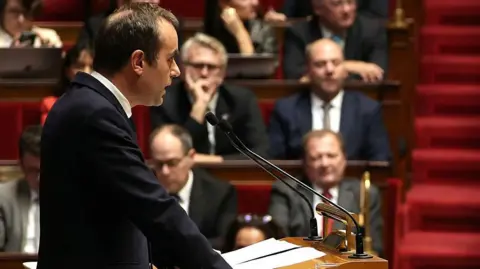
French Prime Minister the government leader has informed parliament that he backs suspending controversial retirement age changes implemented in 2023, in the face of important confidence motions scheduled for Thursday.
The changes, which elevated the pension age from 62 to 64, were regarded as signature reforms in President Macron's administration.
"In the fall I will propose to the assembly that we freeze the retirement age changes until the [2027] presidential election," Lecornu said to support from progressive factions.
The Prime Minister was returned to office days ago only 96 hours after he resigned, and requires the approval of progressive representatives in the assembly if his administration is to survive.
Political Pressure
Political rivals on the right-wing and left-wing have initiated no-confidence motions on the cabinet, for midweek and are demanding parliamentary elections.
The Socialist party stated they would be ready to endorse the cabinet, but only if it commits to a complete halt of Macron's retirement reforms.
"Should he fail to clearly state the words 'total and immediate suspension of the retirement changes', it will be a vote of no-confidence," lawmaker the socialist politician previously stated on French TV.
"His fate lies in his future in his own hands. He understands what he has to do if he doesn't want being the government leader who leaves office every week."
Political History
The reforms were eventually pushed through parliament in March 2023, less than a year after Macron was elected for a second presidential term.
There had been a lengthy time of national controversy, labor protests and public demonstrations, and in the end the bill had to go through without a vote in parliament using a government tool known as 49:3.
Last week, Lecornu said it was something many citizens remembered as a "wound on democracy" .
Budgetary Impact
On Tuesday he explicitly explained to lawmakers that suspending the retirement changes would cost €400m in the medium term and a extra €1.8bn in the presidential election year. This will have to be "compensated by other budget cuts," the Prime Minister announced.
Lecornu is France's third government leader in the past year but even if he does survive he needs to pass a financial plan through the assembly that brings down a budget deficit heading for 5.4 percent of economic output this year.
France's public debt earlier this year stood at €3.4tn, or approximately over 110 percent of GDP, the third largest in the eurozone after Greece and the Italian nation.
Political Strategy
The Prime Minister has been one of Macron's staunchest collaborators, so his decision to reverse course on such a divisive measure shows how eager the president is to avoid further political crisis.
An economics expert, who was jointly awarded the 2025 Nobel economics prize on this week, commented that he supported a halt of the retirement changes, because it would still come at a lower price than the instability that would come after another government collapse.


